
“God Has ‘The One’ For You” And Other Advice To Reconsider
Title: “God Has ‘The One’ For You” And Other Advice To Reconsider
Artwork by:YMI X Estelle Queck (@morethanworks)
Description: You’re a single Christian with hopes of finding a potential partner. There seems to be a shortage of eligible dates in both your church and at your workplace. However, the one thing you’re not short on is advice from friends and acquaintances, all eager to see you partnered up.
Even though our friends mean well, their advice could point us towards self-centeredness rather than Christ-centeredness. The best way to tell is to evaluate what we hear with what the Word says about love. Let’s invite Christ to steer us through the ups and downs of our relationship.
Disclaimer: If what you’ve read here sounds intimidating and impossible to achieve, fret not! It’s meant to help you avoid possible pitfalls in your dating journey and enjoy an exciting one with Christ.
Butterflies in your stomach, sweaty palms. Tingling sensations of excitement scorch through your body as you meet a potential “the one” . “Maybe this is the specific someone God has for me”, you think.
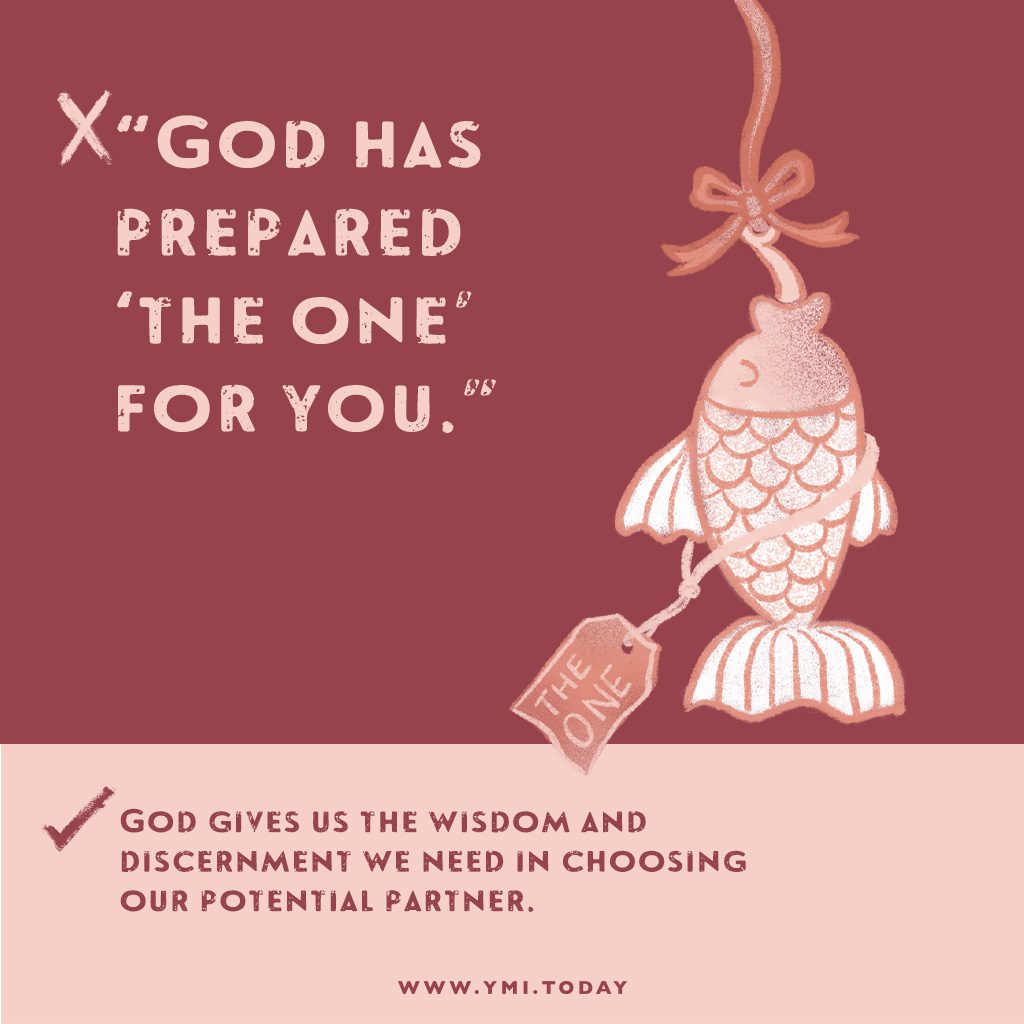
Most of us would have been told, in one form or another, that God has a specific person planned for us, which sends us into a debilitating tailspin of anxiety and fear of choosing the “wrong one” —or feeling like we may have missed out on the “winning prize” when a relationship fails.
But the Bible has never said that God has set aside that “one person” for us. Instead, we are given the freedom to decide whom to marry, but through the Bible, prayer and the help of our community, He gives us the wisdom we need in discerning whether someone would make a good potential life partner (James 1:5).

You blow up each other’s phone with cute text messages, date nights are spent with you in tears of laughter, and you can’t wait till you both get to spend time together again. Your date makes you just so incredibly happy.
While there’s room for happiness in a healthy relationship, it’s an unreliable measure when it comes to figuring out if the person is the right one for us. A better way of gauging the person’s suitability would be to turn to our group of trusted friends for advice. Do they have any concerns about our date’s character, or the way the relationship is headed?
Proverbs 12:15 says a wise man listens to advice, and when it comes to the areas of love and dating, there’s nothing foolish about taking heed of the potential red flags or blind spots our friends might be able to help us see.

You’ve found someone you’re interested in and feel that there’s compatibility between the both of you. But over the first couple of dates, you don’t feel connected. You feel unsure if you should call it quits at this stage.
The reality is, we need to invest time into knowing the other person for a deeper connection to grow.
This can be built over time as we have God-centered conversations about our fears, thoughts, hopes and priorities in life or experience different situations together. Soon, you’ll find that connection is solidified when iron sharpens iron (Proverbs 27:17), in times of carrying each other’s burdens (1 Thessalonians 5:11, Hebrews 10:24), and as you build each other up (Galatians 6:2). Not only does this give us a glimpse into the other person’s character and ability to handle tough situations, but it also helps us better decide if we are ready to pursue a life-long partnership.

You’ve grown in your feelings for that special someone, and so has your expectations of him. Egged on by your friends, you start to evaluate the kind of gifts he showers you with, or what he does to impress you. “Has he brought you to a fancy candlelight dinner or surprised you with a visit?” You begin wondering if he’s truly interested in you if he hasn’t been doing anything special to show how much he cares.
Everyone deserves to be genuinely loved and to receive love. Expecting someone to “love us more” than we love them could run the risk of us playing with their emotions, their vulnerabilities, and their generosity for our own gains and securities.
1 Corinthians 13:3-8 says love is not self-seeking, but always protects the interests of the other person. How can we show honor to the person we’re dating, and to give more than we’re receiving?

You are open to meeting someone, and start looking around church and cell groups for potential partners. Soon, almost everyone you know is looking to introduce you to someone they vaguely know—just because the person’s “a Christian”.
You go on a few dates with the person, and things seem to go well. But if you’re looking to pursue a relationship, then it’s good to ask questions such as: Do they bear the fruit of the Spirit (Galatians 5:22-23)? Do they look out for the forgotten, or the least of these (Matthew 25:40)? Are they looking to grow more like Christ (1 Peter 2:2) and setting aside time to do so? These are just some questions that help us assess whether our future partner is a person who is truly after God’s heart (Acts 13:22).
After all, there is more to the Christian life than just professing to be one—find someone who walks the talk too!

That jolt of electricity when your hands touch. The sound of your heart drumming in your ears. The sight of those expressive eyes and cute smile is enough to melt you.
While the initial physical attraction or “spark” is important, it’ll fade over time. As Proverbs 31:30 says, “Beauty is fleeting, charm is deceptive, but a woman who fears the Lord is to be praised.” And we’ll need more than just the jelly-leg feeling to fan the flames of a relationship over a long period of time.
Instead of focusing on the “spark”, here are some other more attractive traits to look out for: Do they have a heart of generosity or kindness? Or, perhaps a faith that has weathered through the storms of life and fears the Lord in their decision-making? Let these qualities be the fuel that’ll keep your relationship going even after that initial spark is gone.

You’ve been told you’re smart and funny, and that any person would be so lucky to date you. And it’s almost always followed by this: “You deserve the best.”
But what does that look like? Does it mean you can’t date the person volunteering to clean the church’s toilets every Sunday because you’re on the worship team? Does it mean ditching your boyfriend if he’s unable to shower you with expensive gifts?
“Deserving the best” has little to do with a person’s status, or the material gifts they’re able to shower us with. Instead of evaluating whether someone is “the best”, choose someone whose values or life goals align with ours, and encourage each other to pursue Christlikeness in every area of our lives (Hebrews 10:24). What gifts do you see in the other person? Seek ways to help them grow in exercising those gifts.








Amaizing artical, i see there are some questions to ponder right there, wonderful
Very Good and interesting post
Thank God for your wisdom! I will share this to my cell group ❤️
Good stuff. I like the first point. This can’t be emphasized enough.
Does God promise his followers a spouse if they desire one? No.
The Bible doesn’t mention this concept anywhere. It’s not even hinted at. And we often use this idea as a platitude to comfort people, or ourselves. It can also be a way to avoid rejection, or avoid dealing with our own issues.
In Matthew, Jesus clearly states that some people won’t get married (19:10-12) The Bible has good things to say about both marriage and singleness. When Paul talks about this (1 Corinthians 7), he writes that, if you’re single and struggle to control sexual desires, you should try to get married. In 7:39 Paul also says that a widow is “at liberty to be married to whom she wishes, only in the Lord.” Doesn’t sound like Paul believed in soulmates, or received any divine revelations about them.
In this case, the Bible encourages marriage. It does not, however, promise that it’ll work out for you if you do decide to pursue it. He does say that not everyone has the gift of singleness. But I’m sure that there’s many who lack this gift who, despite everything, still don’t find mates. There’s also married Christians who suddenly find themselves single due to freak accidents and unspeakable tragedies. This all sounds cruel and messed up, but we live in a cruel and messed-up world. It’s not necessarily God’s “plan” or God’s “fault.” It’s just a harsh world we live in. Paul himself cautioned singles about marriage “because of the present crisis.” If a Christian is single again because their spouse suddenly died in a freak accident, is that because God wanted to “bless” them with singleness again because of how amazing and wonderful it is? I doubt it. It’s just a bad world we live in.
According to some Christians, if you’re single and never marry in your lifetime, it’s because of God’s will and calling. I don’t know about that. How are we supposed to know that for sure, exactly? Sometimes people will say this will only be revealed to you through long sessions of “prayer/meditation/contemplation,” or something like that. I’ve prayed over this for years, I still desire a relationship leading to marriage, and I still haven’t experienced success in this area of life, and I still haven’t “heard from God” on which path He supposedly wants for me. Maybe we just over-spiritualize the whole thing. And maybe God isn’t all that concerned with it. Maybe He just leaves the choice up to us.
I think cultural changes play a big role in the confusion. Dating is relatively recent phenomenon. In previous centuries of human history, parents were much more involved in finding mates for their children. These days, dating is sort of seen as something to do “for fun,” rather than for economic reasons. Parents, secular and Christian, tend to leave their children on their own to explore the “adventures” of love and hope and pray that it all works out. Sometimes it does, sometimes it doesn’t. But they still assume that God will come through for their kids. You see that at Christian weddings all the time. The parents will usually come forward to pray for their children (usually into the microphone), and they almost always thank God for bringing their children together, and for answering the prayers of both parents and children. The assumption, of course, is that God played a key role in matching them and bringing them together.They won’t be able to find a Bible verse that backs that idea up, but the assumption remains. I think, perhaps unconsciously, Christians and Christian pastors are drawn to the idea of soulmates because it offers an easy way out. There’s no tough questions to ask, no obligation to practically help any Christian singles who desire marriage. “Not married? Want to get married? Discouraged or cynical about ever finding love? Not to worry! Just trust God and love Jesus! Everything will fall into place! Duh!….And if it doesn’t work out, it’s God’s will and God’s perfect plan, so stop complaining.”
If you do want to want to get married, it’s very important to build social skills, financial wisdom, a stable and well-paying career, a place to live, etc. Those things are all crucial. But it’s probably hard sometimes for pastors to find a way to fit practical advice about such topics into a sermon about Scripture.
Is God some sort of cosmic matchmaker? Maybe, I don’t know. If He is, well, He apparently forgot to inspire a biblical author to make that clear in the Bible. Maybe God has nothing to do with it. Maybe it’s just good luck and bad luck. That might sound absurd to some people. Well, the Christianese theology of “soulmates” and “waiting on the Lord” sounds equally absurd sometimes.
And it is difficult and often excruciatingly painful. It’s OK to admit that. It’s not “idolatrous” to badly want marriage. It’s always deeply hurtful to have such strong desires for good things that remain unfulfilled, while God seems to grant them to other Christians for no apparent reason. But maybe God didn’t specifically decide to bless them with romantic love. Maybe those people just got lucky. It can sting a lot, and we don’t have to pretend otherwise by inventing silly Christianese clichés about the “gift of singleness” and “Jesus being our spouse” and “Jesus being enough,” and “being content” and “God will bring you a spouse” and other such nonsense.